

Raw Food Diet (BARF) for Dogs and Cats: The Complete Truth in 2026
If you’ve been scrolling TikTok lately, you’ve almost certainly seen it: dogs devouring raw chicken carcasses, owners doing weekly “meal preps” for their Labradors, influencers claiming their Golden Retriever has regained 5 years of vitality on a raw diet. The raw feeding movement is exploding — and with it, a wave of legitimate questions. Is it actually good? Is it dangerous? Is it expensive? And is it right for you?
This guide takes no ideological position. It gives you the facts, the science, and the practical advice to make an informed decision.
What Is BARF, Exactly?
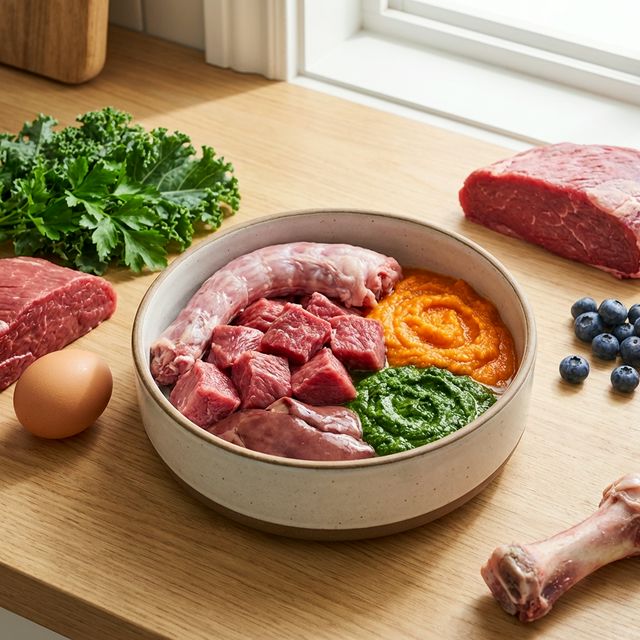
BARF stands for Biologically Appropriate Raw Food (or, in the original formulation: Bones and Raw Food). It’s a dietary approach based on the idea that dogs and cats have a physiology adapted to consuming raw foods — meat, raw meaty bones, organ meat, vegetables — rather than ultra-processed kibble.
The concept was popularized in the 1990s by Australian veterinarian Ian Billinghurst, who argued that dogs should eat what their evolutionary ancestors ate. Since then, the movement has split into several distinct schools:
| Approach | Description |
|---|---|
| Classic BARF | Raw meat + raw meaty bones + organs + vegetables/fruits |
| Prey Model Raw (PMR) | 80% meat, 10% bone, 10% organs — zero vegetables |
| Franken Prey | Reconstitutes a “whole animal” using parts from different species |
| Semi-raw (Cooked Raw) | Lightly cooked meat, steamed vegetables — a compromise for the cautious |
Why Raw Feeding Is Exploding Right Now
This isn’t random timing. Several forces are converging:
1. Anti-ultra-processed thinking extends to pets.
The Millennial/Gen Z generation that reads food labels for themselves has logically extended that scrutiny to their pets. If you care what’s in your food, you read your dog’s kibble bag too.
2. Pet food safety scandals.
Multiple kibble recalls for contamination (Salmonella, aflatoxins) have eroded trust in industrial brands. Raw feeding appears as a “transparent” alternative where you know exactly what’s in the bowl.
3. TikTok virality.
Raw feeding content accumulates millions of views. A dog enthusiastically demolishing a large bone is intrinsically viral — and creates a normalization effect.
4. Visible results (sometimes).
Owners report shinier coats, reduced itching, better breath, smaller and less odorous stools. These testimonials, while anecdotal and inconsistent, fuel the trend.
The Real Advantages of BARF (Evidence-Based)
The research on BARF is still limited compared to decades of kibble studies — but here’s what published evidence shows:
✅ Better Protein Digestibility
A 2019 PLOS ONE study showed that BARF-fed dogs had significantly better digestibility of proteins and essential amino acids compared to extruded kibble. Raw proteins don’t undergo the degradation caused by the high temperatures used in kibble manufacturing (150–200°C).
✅ More Diverse Intestinal Microbiome
Preliminary research (University of Helsinki, 2021) suggests raw-fed dogs show greater gut microbiome diversity — associated with better immune function. This finding awaits large-scale confirmation.
✅ Smaller, Less Odorous Stools
Consistently observed across virtually all BARF adopters: stools are significantly smaller (better nutrient absorption) and far less odorous (fewer undigested fermentable residues).
✅ Dental Benefits from Raw Meaty Bones
Raw meaty bones (chicken, rabbit) are a natural and highly effective dental cleaner. The mechanical chewing action prevents plaque better than most chew toys or veterinary toothpastes.
The Real Risks of BARF: Don’t Underestimate Them
⚠️ Bacterial Risks (Salmonella, Listeria, Campylobacter)
This is the primary concern raised by skeptical vets, and it’s legitimate. Raw meat contains pathogenic bacteria. Dogs and cats generally handle these well (their digestive systems are more acidic than ours), but:
- Human risk: Handling raw meat without strict hygiene can infect owners — particularly children, pregnant women, and immunocompromised individuals.
- Animal risk: Immunocompromised, very young, or very old animals are more vulnerable.
- Solution: Rigorous hygiene (gloves, decontaminated surfaces) + pre-freezing at -20°C for 3 days (significantly reduces pathogen load).
⚠️ Bone Risks (Obstruction, Dental Fracture)
Not all bones are appropriate. Absolute rule: never cooked bones (they splinter and become dangerous). Raw meaty bones (with meat still attached) are generally safe. Large mammal bones (beef femur) can fracture teeth.
Appropriate bones:
- Chicken/turkey necks (small dogs, cats)
- Chicken/rabbit backs, whole rabbit
- Lamb necks
Avoid:
- Cooked bones of any kind (ALWAYS forbidden)
- Large long beef/pork bones (too hard)
- Fish bones (except whole mackerel)
⚠️ Nutritional Imbalances (The Most Underestimated Risk)
This is arguably the most serious long-term risk: a poorly formulated BARF diet can be deficient in calcium, vitamins D, E, iodine, zinc, or manganese. Chronic deficiencies develop over months before becoming clinically visible.
A balanced BARF diet must respect precise ratios:
- Muscle meat: 70%
- Raw meaty bones: 10% (primary calcium source)
- Organs: 10% (including at least 5% liver — source of vitamins A, B12)
- Vegetables/fruits: 10% (optional depending on the school of thought)
⚠️ Consult a veterinary nutritionist before starting, especially for puppies (very different needs), pregnant females, and animals on medication.
⚠️ Cost: Usually Underestimated
BARF costs more than mid-range kibble, and roughly the same as premium kibble:
| Animal | Weight | Monthly BARF cost | Monthly premium kibble cost |
|---|---|---|---|
| Cat | 4 kg | €40–60 | €30–50 |
| Small dog | 8 kg | €50–80 | €40–60 |
| Medium dog | 20 kg | €80–130 | €60–100 |
| Large dog | 35 kg | €130–200 | €100–150 |
Budget tips: buy in bulk from butchers selling “non-retail” meat (perfectly safe, less visually appealing), freeze in meal-sized portions.
BARF for Dogs vs. BARF for Cats: Critical Differences
Cats are not small dogs. Their biology imposes different nutritional rules.
The Cat: An Obligate Carnivore (No Margin for Error)
Unlike dogs (omnivores), cats are obligate carnivores. Their body cannot synthesize certain essential nutrients that must come exclusively from meat:
- Taurine (essential for heart and vision) — found in organ meat, particularly heart
- Arginine — deficiency causes ammonia toxicity within hours
- Arachidonic acid — hormonal precursor they cannot synthesize from plant sources
- Preformed Vitamin A — they cannot convert it from beta-carotene
🐱 For cats on BARF: no vegetables needed, prioritize organ meat (especially heart = taurine source), and veterinary monitoring is mandatory.
How to Start BARF: 10 Steps
Step 1: Consult Your Vet First
Some animals are not BARF candidates (kidney disease, immunosuppression, complex allergies).
Step 2: Choose Your Approach
Classic BARF, Prey Model, or a mixed approach? Research the different schools and choose what fits your philosophy and practicality.
Step 3: Don’t Switch Overnight
Gradual transition over 2–4 weeks:
- Week 1: 75% old food + 25% BARF
- Week 2: 50/50
- Week 3: 25% old + 75% BARF
- Week 4: 100% BARF
Mild loose stools at transition onset = normal. Persistent or severe diarrhea = call your vet.
Step 4: Start With One Protein
Chicken first (highly digestible). Wait 2 weeks before introducing a second protein — this allows you to identify any intolerances.
Step 5: Respect the Base Ratios
- 70% raw muscle meat
- 10% raw meaty bones
- 10% organs (half of which is liver)
- 10% vegetables (for dogs)
Step 6: Calculate Daily Ration
General rule: 2–3% of body weight per day (2% for sedentary, 3% for very active dogs). A 20kg dog → 400–600g of BARF per day. Cats: 3–4% of body weight.
Step 7: Pre-Freeze All Meat
-20°C for at least 3 days before use. Significantly reduces pathogens (toxoplasma, listeria). Defrost in the refrigerator — never at room temperature.
Step 8: Strict Hygiene
Clean bowls after every meal. Decontaminate preparation surfaces. Don’t let your pet lick your face after eating. Particularly important with young children or elderly people in the household.
Step 9: Supplementation (Often Necessary)
Most commonly recommended supplements:
- Salmon/krill oil: Omega-3 (anti-inflammatory, coat health)
- Cod liver oil: Vitamin D (especially in winter)
- Ground eggshell: Calcium (if low on raw bone)
- Kelp seaweed: Iodine (especially for cats)
Step 10: Monitor and Adjust
Weigh your pet every 2 weeks for the first 3 months. Blood panel at 3 months to verify calcium, phosphorus, vitamin D levels. Observe: coat, stools, energy, weight.
BARF vs. Kibble: The Honest Comparison
| Criterion | BARF | Mid-range Kibble | Premium Kibble |
|---|---|---|---|
| Ingredient quality | ⭐⭐⭐⭐⭐ | ⭐⭐ | ⭐⭐⭐⭐ |
| Convenience | ⭐⭐ | ⭐⭐⭐⭐⭐ | ⭐⭐⭐⭐⭐ |
| Monthly cost | ⭐⭐–⭐⭐⭐ | ⭐⭐⭐⭐⭐ | ⭐⭐⭐ |
| Bacterial risk | Moderate if well managed | Low | Low |
| Nutritional imbalance risk | High if poorly formulated | Low | Low |
| Dental health | ⭐⭐⭐⭐⭐ | ⭐⭐ | ⭐⭐⭐ |
| Digestibility | ⭐⭐⭐⭐⭐ | ⭐⭐ | ⭐⭐⭐⭐ |
| Ingredient control | Total | None | Partial |
FAQ: Everything You Wanted to Know About BARF
Can raw feeding make my dog aggressive?
No. This is a persistent myth. Aggression is related to temperament, training, and emotional balance — not diet. No behavioral studies have ever established a link between raw feeding and increased aggression.
My vet is against BARF. What should I do?
Many veterinarians received nutritional training funded by industrial pet food brands (Hills, Royal Canin, Purina), which can create bias. This doesn’t mean they’re wrong about real risks. For a more balanced perspective, seek a second opinion from a veterinary nutritionist (DACVN board-certified in North America, DECVN in Europe).
Can I mix BARF and kibble?
Yes, technically. The theory that “they don’t mix” (different digestion speeds) is contested by many nutritionists today. A mixed diet can be a good transition strategy or a long-term convenience compromise.
Is BARF suitable for senior dogs?
It depends. For a healthy senior dog, BARF can be excellent (better protein digestibility, dental benefits). For a senior with kidney disease, BARF’s phosphorus levels may be problematic. Veterinary consultation is mandatory.
Can I prepare BARF multiple days in advance?
Yes. Most BARF owners prepare a week’s worth of portions and freeze them. Defrost the previous evening in the refrigerator. A thawed portion shouldn’t be kept more than 2 days in the fridge.
Can BARF work on a tight budget?
Yes, with resourcefulness. Approach local butchers for “butcher’s offcuts” — often very affordable. Discount freezer shops sometimes carry appropriate meats at significant savings. Buying in bulk and freezing can halve your per-meal cost.
My cat refuses to eat raw food. What do I do?
Cats are neophobic (averse to new foods). Transition must be ultra-gradual: start by adding one teaspoon of raw chicken on top of their regular food, changing nothing else. Allow several weeks. Never force it — a cat who doesn’t eat for more than 24–48 hours risks developing hepatic lipidosis (veterinary emergency).
Conclusion: BARF — Right for Whom?
BARF is excellent nutrition if you have the time, budget, and rigor to formulate it correctly and manage hygiene properly. It’s not a passing trend — it’s a return to biologically appropriate feeding for carnivores and omnivores.
It’s not right for you if you travel frequently, lack the time for meal preparation, or have an animal with strict medical nutritional requirements.
The good news? You don’t have to commit 100%. Quality kibble + a weekly portion of raw or lightly cooked meat is already a significant step forward.
The best diet for your pet is the one you can offer them consistently, balanced, and with love.
This article is for informational purposes only. Always consult your veterinarian before changing your pet’s diet, particularly for young animals, seniors, and animals under medical treatment.